A shoe rack… finally finished

Sometime last winter I had decided that it was time to replace the ugly cheap shoe cubes that sit in the mud room.  I figured that I could build a quick set of shoe racks that would last until I decided to eventually renovate the mud room.  Of course I started the project, and then other things came up and I didn’t finish (yes, I’m good at starting projects, a little less good at finishing them).

Shoe Rack Completed
Completed project after second coat of varnish

So the project sat in the basement until this week.  Partially completed.  I had milled the lumber out of scrap red oak.  Of course the shop isn’t heated in the winter, so I did rush and didn’t really spend much time picking out the wood for the project.  The pile of red oak I have isn’t the nicest wood.

It was a pretty hasty construction.  The rails and stretchers are attached to the legs using pocket hole screws.  The slats are just glued to the supports.  All the stretchers, rails and slats were milled to 1/2″ thickness, and some small details were routed into the legs.

So what do I not like about the shoe rack?  Several things.  I would debate remaking the whole project if it weren’t temporary, but it is better than what I have, and I have lots of other projects to work on.
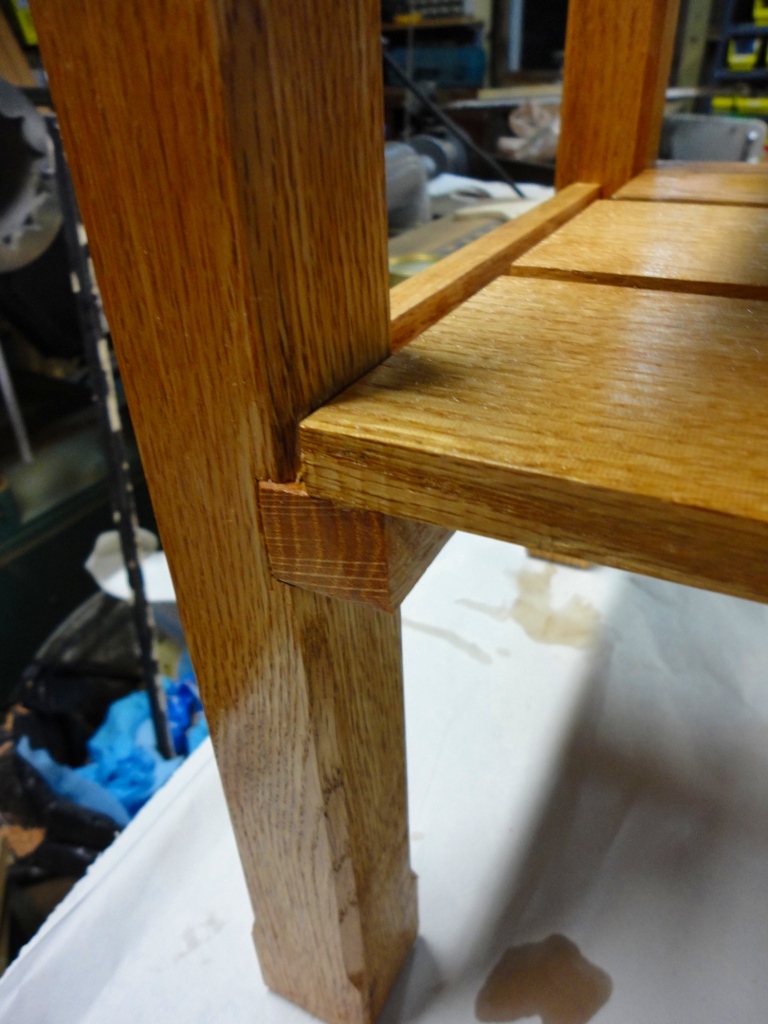
Slats attached to stretcher

From a design standpoint, I don’t like the supports for the slats.   The stretchers are attached in the middle of the leg, so to get a gluing surface I milled a 3/4″ square piece of oak and cut a dado into the legs to support the support.  Then the slats were glued to the surface. No end grain gluing, so it is pretty strong…. We’ll see if it fails over the next couple of years.  I think I would make the shelves similar to a door, using rails and stile construction, and then just sliding the shelves into the dados.

The other design change would be to make the shelf slats out of thicker material.  The 1/2″ oak is feels a little too flimsy across the span.  Maybe mill it to 5/8″ vice 1/2″.

I think also changing from pocket hole screws to mortise and tenon joints would look much nicer.  Maybe I’m still afraid a little to try my own mortise and tenon joints.
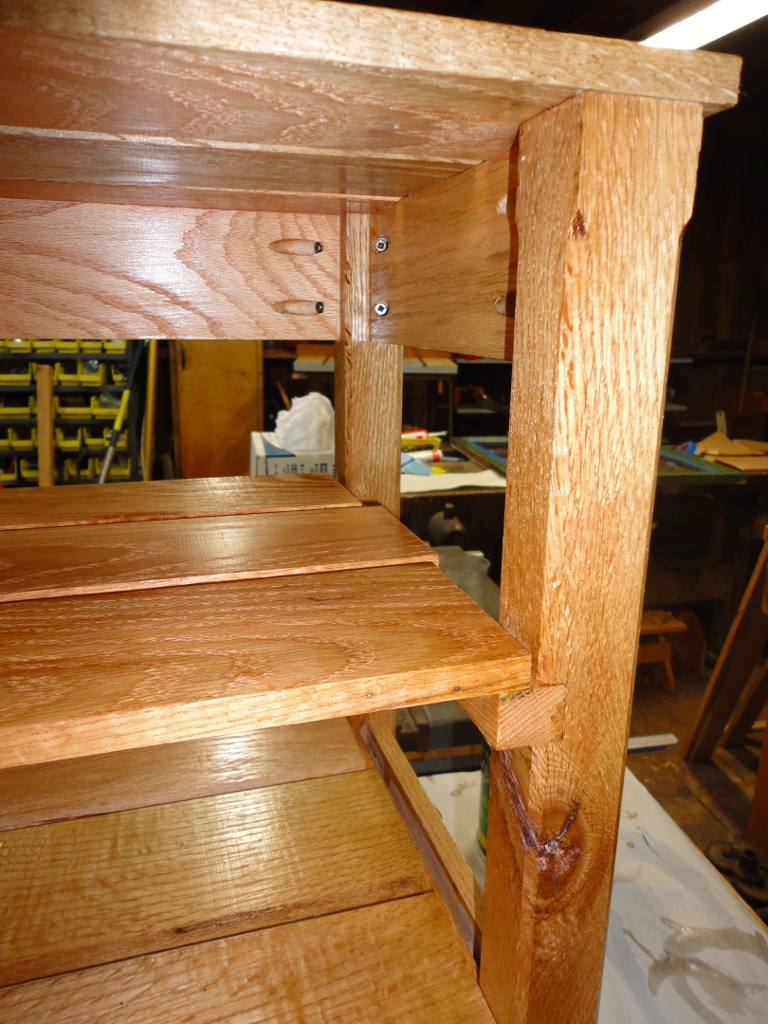
Pocket Hole Joinery

From a construction standpoint?  I made several mistakes.  First, I should have spent more time looking through the lumber stack to find better wood .  Look at the picture on the left and see the big knot in the leg.

I also cut one of the slats the wrong length… I felt too lazy to mill another part and get it to the right length.  Of course it was cut too short.  I could have shortened the rest of the slats, but didn’t think that would look good.

I should have constructed the frame, and then attached the lower shelves first.  That would have ensured that the frame was square (there is no front stretcher to ensure that).  It turns out that the front is maybe 1/16″ wider than the back.

I didn’t spend much time finishing the project.  It is only going to have shoes put on it… and will eventually be replaced with something more permanent when I redo that room.  I should have given myself one more night to sand the slats before gluing them on.  My planer still makes little ridges on the surface (I think one blade is the wrong height – I really should check it before the next project).  The oak isn’t the straightest grain, so I did get tear out.  Maybe this is an area where a drum sander to take the boards to the final thickness would help.

I did a single coat of shellac followed by two coats of wiping varnish. Maybe I should add a third coat tomorrow night, at least to the visible parts.

What is the next project?  I think a quick set of outside benches out of 2x4s for next to the fire pit.  Another nice project I can cheat with pocket hole screws.  I still think I need to make a storage shelf for the study/guest room.   And bunk beds for the boys.  On top of that lots of house projects to finish.
Workbench

Approximately two months ago I decided to enter the Sawdust Chronicles 2010 build challenge.  Here is the writeup from that project.

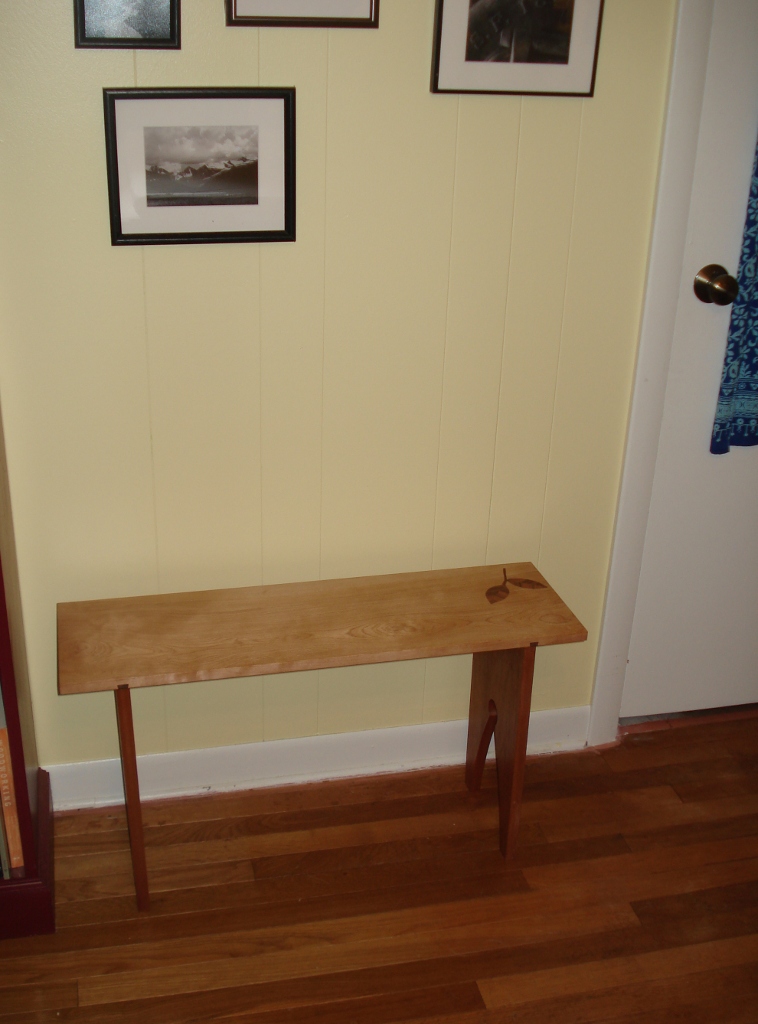
Here is the final project:

final-in-room
The final bench project

I finished the build project.  I wasn’t sure if I was going to make it (it has been a busy month).  But I was able to do the final assembly and finish today…  I may decide to do another coat of varnish on the top of the bench at a later date, but it is completed and added to the furniture in the house.

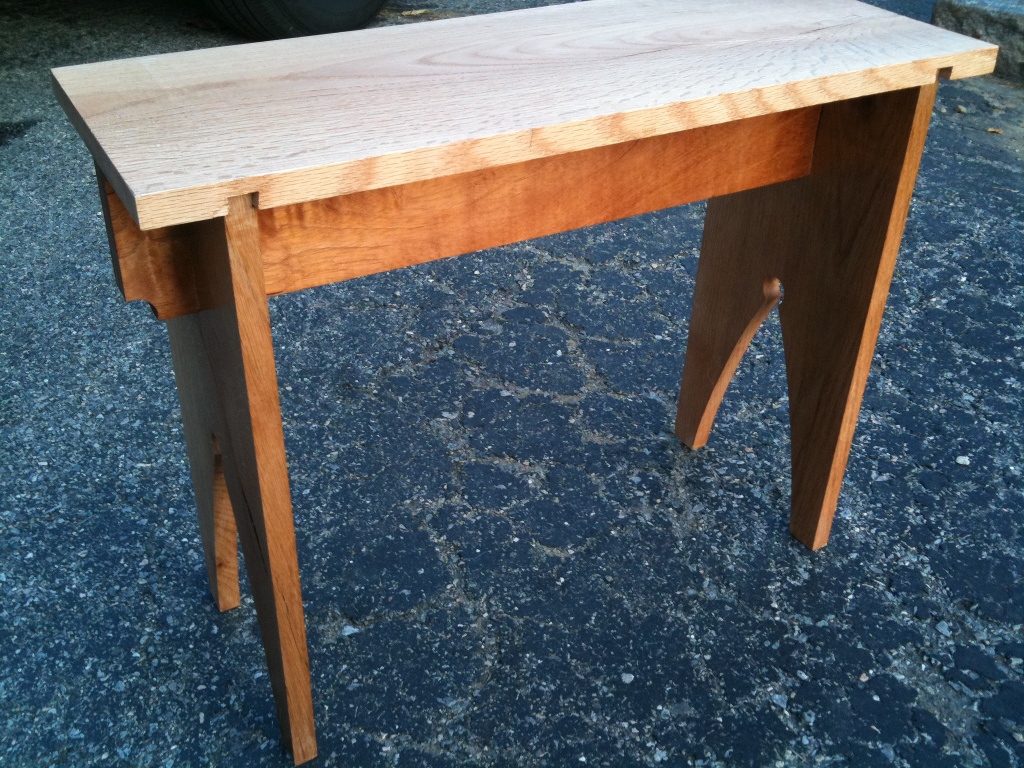
What were my challenges?  I had initially thought of doing a bench out of red oak with an inlay.  However the oak is turned out pretty plain (too mid-toned – I wanted a lighter shade of wood for the top).  So I used the oak to make a prototype bench.  What a great idea.  It was a technical challenge – I had never constructed something like this before – and a design challenge – I didn’t really like the original design/proportions.  Overall it was a great learning project, and even better to have a deadline to work to to force me to finish it, even if I had to work a little faster than I liked by the end.

After I constructed the prototype, I posted it for comments on lumberjocks.com.  Based on those comments (and my ideas), I decided to change the design of the bench:

prototype-for-comparison

– I would keep the legs with the same curve, but add a bigger diameter hole.
– I made the stretcher a lot smaller, more in proportion to the legs, and added a gentle curve to the stretcher.
– I made the top longer (32″ long) – It would fit the location better.
– I made the stretcher the same thickness as the stock from the legs, it seemed to be a better proportion.

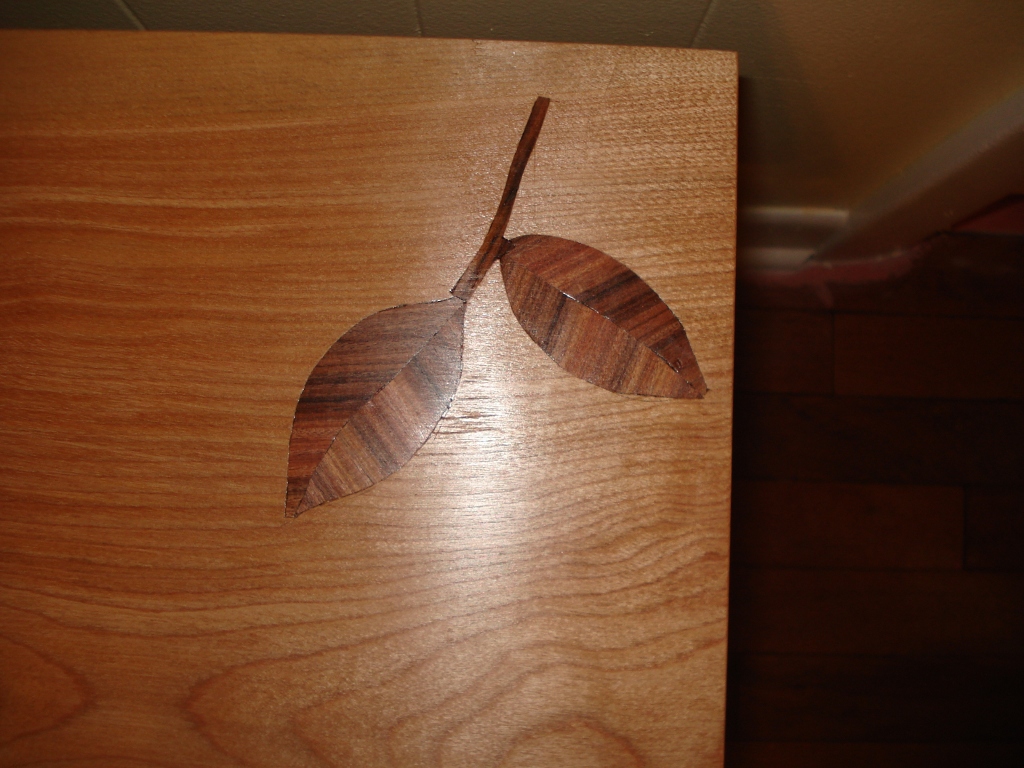
The first step of the construction was to make the top, and inlay the leaves.  I made the top of birch (I believe).  I cut the leaves on the scroll saw and cut the inlays with the router (based on a podcast by Marc Spagnuolo).  It turned out to be more challenging than it appeared by the podcast, but overall I like how the inlay turned out, and will probably incorporate that type of inlay into future projects.

inlay
Leaf Inlay Detail

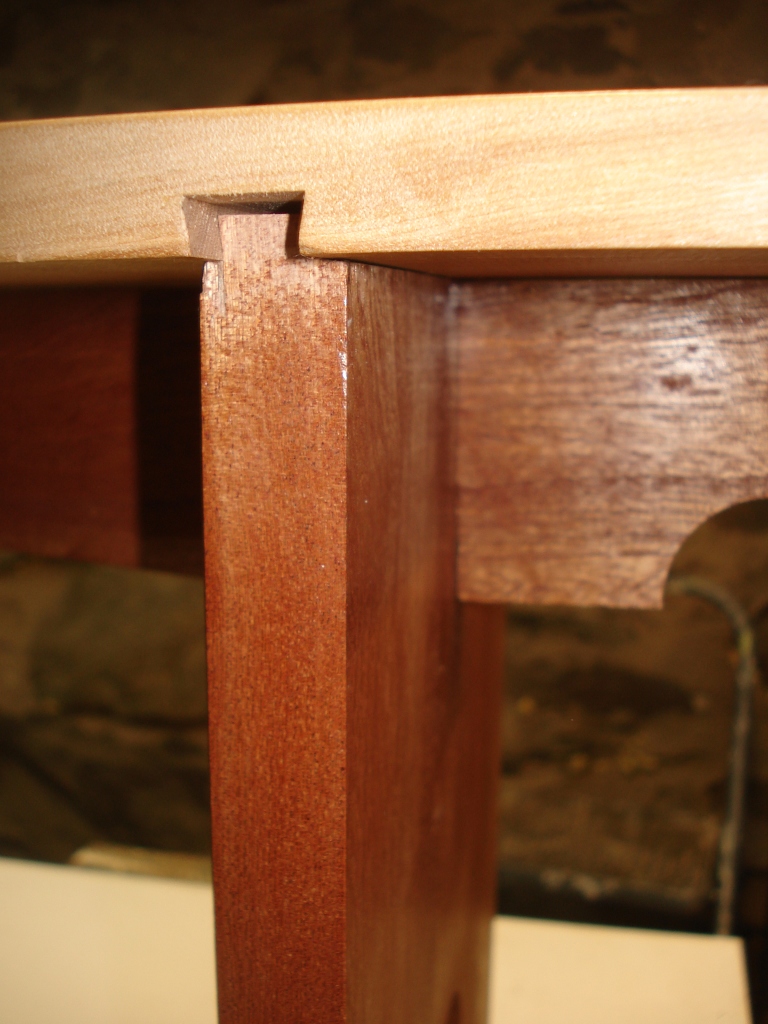
I routed the sliding dovetail slot on the top.  On the prototype I made a stopped dovetail, on this one I made a through dovetail and used a piece of scrap walnut as a filler for the front of the dovetail.  I didn’t fill the back of the dovetail (so the bench can come apart, but not easily right now).  I think if I had more time I may have added one for the back.

I then glued up the legs from sapele and milled the stretcher from the same.  I believe it is sapele, but I have acquired a lot of lumber from a friend, and it wasn’t all labeled very well.

I cut the dovetail on the legs on the router table.  I did cut the legs a little long, to ensure that if I cut too much off in making the dovetails, I could start over and not have to throw the legs away.  After routing the dovetail on the legs, I cut the legs to length, and then drilled the hole and used the same template I used on the prototype to make the legs.  I rough cut the curves on the bandsaw and used a pattern bit on the router to get the final shape.

I cut the curve on the stretcher and used a pattern bit to rout the curve to final shape.

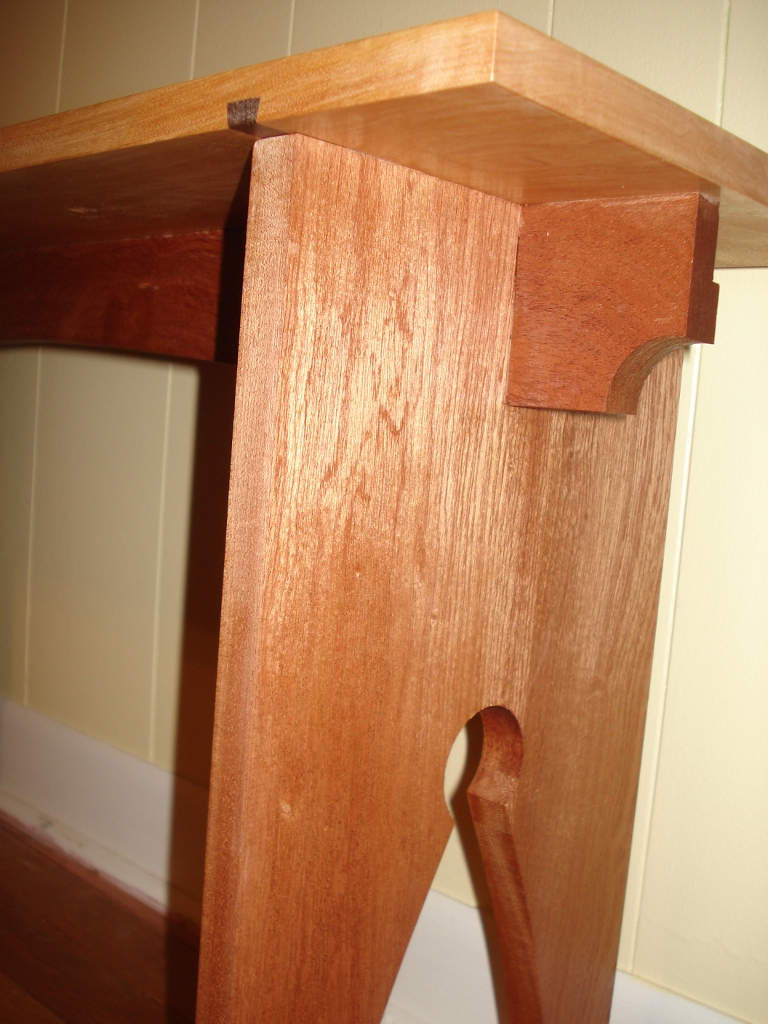
The stretcher and legs are joined by a half-lap joint, and then the while leg/stretcher assembly is then attached to the top using a sliding dovetail.  I used an American Woodworking project as inspiration for the construction method.  I cut the slots for the legs/stretcher on the bandsaw and cleaned up by hand.

What did I do wrong?  I made a couple of technical mistakes on the final project.  The half-lap joints aren’t as clean as I would like them to be.  I had the same problem on the prototype.  I may have been rushing a little bit to get the project out the door on the final project.  I also started to drill one of the cutouts at the end of the stretcher on the wrong side.  It is on the back so isn’t very visible, but if I had more time, I would have cut a new stretcher and started over.  I also finished the top prior to assembly, but didn’t have time to prefinish the rest of the pieces.  I think it would have been easier to finish if I had prefinished all of the pieces.

What would I do differently the next time?  Maybe use wood that would contrast even more (maybe ash for the top and walnut for the legs).  I would prefinish all the pieces.  I would try to get the half-lap joints tighter.  I really liked the idea of building a full-sized prototype to help with construction and design ideas (I included a picture of the prototype to show the differences).

What were my costs?  I purchased the red oak at $1/bdft, and the birch and sapele for about the same.  Even if I had to pay market for the lumber, I didn’t use much lumber to create the project, maybe 8 bdft.  Total cost for lumber I’ll say is $50.  Plus $15 for a can of wiping varnish and $5 for glue and sandpaper for a total construction cost of $70.

The only tools I purchased for this was a new dovetail bit for the router (maybe $20).

Below are pictures of the project

sliding-dovetail-detail side-picture


Chuck Curtis